
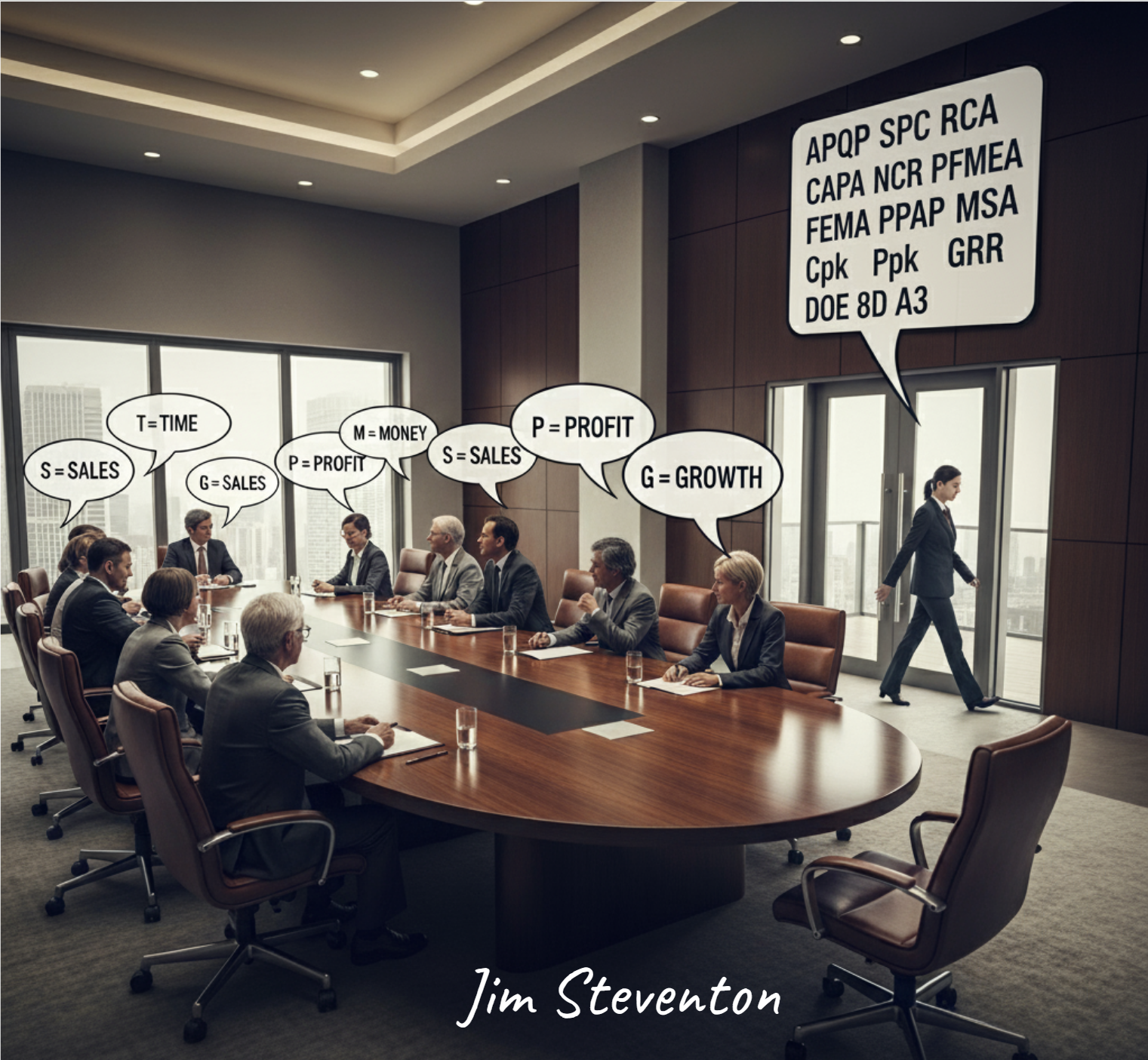
Quality needs to learn a different language.
The history of corporate governance is littered with stories of talent leaving the boardroom. But few departures are as universally frustrating—and as quietly devastating to an organization’s long-term health—as that of the Quality Professional.
These aren’t cases of poor performance. These are professionals grounded in robust methodologies—Six Sigma, Lean, Deming’s principles—who are tasked with ensuring the very integrity of the product and the efficiency of the processes that create the company’s value. Yet, for decades, many have found themselves on the outside looking in, their voices fading into a boardroom silence.
The reason is simple, pervasive, and often unconscious: They spoke a different language.
The Two Tongues of the Organization
A modern company’s leadership speaks the language of Business and Finance. It’s a dialect of EBITDA, Return on Investment (ROI), Cash Flow, Debt-to-Equity Ratios, and Shareholder Value. It’s a language focused on outcomes—the ‘what’ and ‘how much.’
The Quality Professional, on the other hand, speaks the language of Process and Prevention. It’s a technical dialect rich with terms like SPC (Statistical Process Control), APQP (Advanced Product Quality Planning), MSA (Measurement System Analysis), PPAP (Production Part Approval Process), and FMEA (Failure Modes and Effects Analysis). It’s a language focused on inputs and systems—the ‘how’ and ‘why.’
When these two groups gather, the conversation quickly devolves from a strategic debate into a game of corporate charades.
1. The Finance Dialect: The Language of ‘After’
The finance and business leaders are inherently focused on lagging indicators. They want to know:
- “What was the cost of poor quality last quarter?” (A financial metric, after the fact.)
- “What is the revenue increase projected from this new product?” (A sales metric, focused on the outcome.)
- “What is the payback period for this new machinery?” (An investment metric.)
Their language is about dollars and sense, about the scoreboard after the game has been played.
2. The Quality Dialect: The Language of ‘Before’
The Quality Professional, meanwhile, is focused on leading indicators—the variables that predict success or failure. They want to discuss:
- “The Cpk (Process Capability Index) on Critical-to-Quality characteristic ‘X’ is trending down.” (A statistical predictor of future defects.)
- “We need to dedicate resources to an FMEA deep-dive on the new design to prevent catastrophic field failures.” (A proactive, preventative measure.)
- “Our MSA shows the gauge measuring feature ‘Y’ is introducing 30% error, making our data unreliable.” (A systems-integrity warning.)
Their language is about process health, about making sure the team is playing well during the game.
When the Quality professional says, “Our Control Charts show we need to implement a Gage R&R study to improve our Cpk,” the business leader hears: “Unscheduled downtime and an unbudgeted expense for something I don’t understand.”
The Three Fatal Translation Failures
The communication breakdown isn’t a mere disagreement; it’s a profound failure to translate value, resulting in three fatal flaws for the quality agenda.
1. The Prevention vs. Reaction Trap
Boardrooms are intrinsically wired to solve problems that are on fire right now. A sudden drop in sales, a legal threat, a supply chain collapse—these get immediate funding and attention.
Quality is about prevention. It’s about spending a moderate amount of money today to avoid a catastrophic, unbudgeted, reputation-damaging failure three years from now.
When the Quality Director asks for $50,000 to train the team on APQP principles, the finance head sees an immediate cost. When a recall costs $50 million, the finance head sees a crisis that must be addressed, often without connecting it back to the lack of that earlier, preventative training. The value of prevention—a cost not incurred—is notoriously difficult to measure and defend in a budget meeting.
2. The Technical Depth vs. Strategic Breadth
Quality methodologies like SPC and Six Sigma are profoundly technical. They require deep expertise to implement correctly.
The boardroom’s expectation, however, is strategic breadth. They want the summary, the ‘so what,’ and the impact on the bottom line.
The Quality Professional often fails by presenting the data and the methodology (e.g., “We used a 2k Factorial Design of Experiments and found that factor ‘A’ and the ‘A*B’ interaction were significant…”), when the board only needed to hear the implication (e.g., “By adjusting two machine settings, we can eliminate 80% of our highest-cost defects, saving $2.5 million annually and increasing customer satisfaction by 15%.”).
The technical depth, while necessary for the process, alienates the decision-makers who feel that either the Quality Professional is deliberately using jargon to sound important, or is incapable of distilling complex issues into simple, actionable business truths.
3. The Lack of a Financial Business Case
Ultimately, the most critical failure is the inability to fully convert Quality metrics into Financial metrics.
A Quality Professional must be able to translate:
- Cpk Improvement → Reduction in Scrap and Rework Costs → Increase in Operating Margin.
- FMEA Implementation → Decrease in Field Failures and Warranty Claims → Preservation of Brand Equity and Reduction in Warranty Reserve Funding.
- MSA Implementation → More Reliable Data → Fewer Misdirected Improvement Projects → Increase in ROI on Capital Investment.
When the Quality professional cannot articulate their needs and successes in the Board’s native tongue—money—they are perceived as cost centers rather than value enablers. They are seen as guardians of arcane charts and procedures, not as strategic partners in profitability and risk mitigation.
Reclaiming the Seat: Learning to Be Bilingual 🗣️
The departure of Quality from the boardroom isn’t just a loss for the individual; it’s a massive loss for the company, often setting the stage for future crises. If Quality isn’t at the table, the decisions made—on cost-cutting, outsourcing, or new product design—will inevitably compromise the system’s integrity.
To reclaim their seat, Quality Professionals must become bilingual leaders:
- Translate, Don’t Just Present: Every metric must have an attached financial impact. If you talk about a 100,000 investment in APQP training, frame it as a 3:1 ROI based on historical reduction in new-product launch costs.
- Focus on Risk and Margin: Position Quality not as a department of policing standards, but as the company’s primary engine for risk mitigation and margin protection. A successful quality system is a low-risk, high-margin business model.
- Use the Customer Voice: The one language everyone in the boardroom understands is the Voice of the Customer (VOC). Connect a failing SPC chart directly to potential customer complaints, lost market share, and public relations nightmares.
The journey back to the boardroom requires more than technical mastery; it requires organizational fluency. The Quality Professional must master the art of speaking about SPC while thinking about EBITDA. When they can fluently connect the technical rigor of their profession to the financial outcomes that drive the board, the silence will finally break, and their indispensable role will be secure.