The digital age, with its speed and complexity, has introduced modern equivalents of traditional manufacturing problems: technical debt, slow feedback loops, and security vulnerabilities. These issues point to operational immaturity. To build more resilient and sustainable systems, we must shift from a reactive “inspect and fix” approach to a proactive “build it right the first time” culture.
This blog translates ten core principles of operational excellence from Lean manufacturing and the Toyota Production System (TPS) into actionable practices for the software and AI industries. These principles—including Poka-Yoke, Jidoka, and Kaizen—are not outdated concepts but a universal framework for solving problems by systematically eliminating waste and embedding quality at every step.
Table 1: The Ten Principles of Built-in Quality
| Principle | Manufacturing Context | Software/AI Analogy | Core Benefit |
| 1. Poka-Yoke | A jig that prevents a part from being installed incorrectly. | A disabled ‘Submit’ button on a form until all required fields are filled. | Prevents errors from becoming defects. |
| 2. Jidoka | An assembly line that automatically stops when a defect is detected. | An automated build that fails and stops the pipeline when a unit test breaks. | Builds quality in at every step by stopping the process when an abnormality is detected. |
| 3. Andon | A pull cord or light that signals an abnormality on the line. | A build monitor on a shared screen or a PagerDuty alert for a service outage. | Transforms hidden problems into visible, shared issues for immediate response. |
| 4. The 5 Whys | Asking “why” repeatedly to find the root cause of a machine failure. | A post-mortem analysis to trace a production bug back to a process failure. | Shifts focus from blaming individuals to fixing systemic process issues. |
| 5. Kaizen | A culture of continuous, incremental improvements by all employees. | Agile retrospectives that lead to small, ongoing changes in team processes. | Fosters a mindset of continuous learning and innovation. |
| 6. Standardized Work | Documenting the “current best way” to perform a task. | Automated runbooks and consistent coding standards. | Creates a stable baseline for all future improvements. |
| 7. Visual Management | Using color-coded bins and performance charts on a wall. | Kanban boards and real-time dashboards that display key metrics. | Makes the status of work and performance clear at a glance. |
| 8. Kanban | Limiting physical inventory between workstations. | Limiting Work-in-Progress (WIP) on a team’s task board. | Reduces multitasking and prevents bottlenecks by optimizing workflow. |
| 9. Gemba Walk | A manager physically walking the factory floor to observe work. | A leader observing a team’s digital workflow and listening to their challenges. | Connects leaders with the reality of the work to challenge assumptions and build trust. |
| 10. Value Stream Mapping | Visualizing all steps of a process from raw material to finished product. | Mapping the Software Development Lifecycle from idea to production. | Identifies all sources of waste and highlights the most impactful areas for improvement. |
1. The Foundational Principle: Poka-Yoke (Mistake-Proofing)
Poka-Yoke prevents errors from happening. In manufacturing, it’s a physical device that makes it impossible to assemble something incorrectly. In software, this is seen in input validation on a form, automated linters that enforce coding standards, or version control systems like Git that allow easy rollback. For AI, it’s about using automated data validation to prevent flawed data from training a defective model and canary releases that automatically roll back a model if its performance degrades. Modern Poka-Yoke is evolving from static rules to AI-driven systems that can predict potential failures before they occur.
2. The Principle of Autonomy: Jidoka (Automation with a Human Touch)
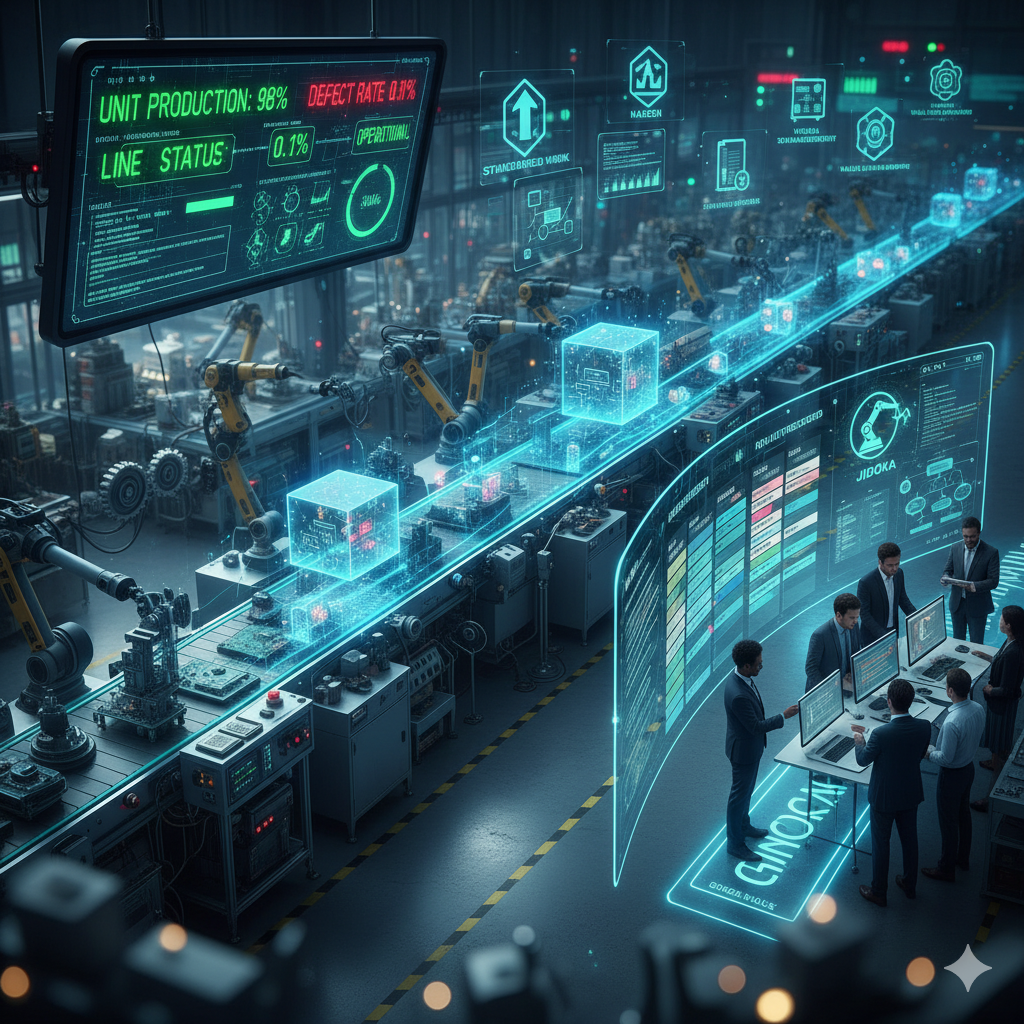
Jidoka is the principle of empowering processes and machines to detect an abnormality and stop work immediately. The famous example is a loom that halts when a thread breaks. In software, the CI/CD pipeline is the perfect Jidoka system. When a build fails due to a broken test, it automatically stops, preventing faulty code from being deployed. This temporary halt addresses the problem at its source, saving the organization from far more costly issues later. For AI/ML, an automated system can monitor a model’s performance in real time and automatically trigger an alert or roll back to a previous version if it detects issues like data drift. This requires a cultural shift where engineers are empowered to “stop the line” to fix a problem.
3. The Principle of Visibility: Andon (The Real-Time Alert System)
Andon is the communication layer that makes Jidoka possible. It’s a system of visual and auditory signals that alert people to problems in real time. The classic red light, yellow light on a factory floor signals an immediate need for help. In software, this translates to a build monitor on a shared screen, a PagerDuty alert for a service outage, or an APM dashboard showing a sudden spike in errors. For AI/ML teams, it’s an automated alert when a model’s accuracy drops or its latency increases. Today’s digital Andon systems are moving beyond simple signals to provide rich, real-time data and even predictive insights, transforming them into intelligent decision-support tools.
4. The Principle of Root Cause: The 5 Whys Analysis
This technique, pioneered at Toyota, is a powerful way to get to the root cause of a problem by repeatedly asking “why?”—typically five times. The goal is to move beyond surface-level symptoms and human error to uncover systemic process failures. In software, the 5 Whys is a core part of post-mortem analysis for bugs or process failures. Applying it forces teams to focus on fixing the system, not blaming individuals. This creates a culture of psychological safety where team members feel empowered to raise issues without fear of reprisal.
5. The Principle of Iteration: Kaizen (Continuous Improvement)
Kaizen is the philosophy that all employees should be engaged in making small, incremental improvements. The cumulative effect of these small changes leads to significant advancements. In software, this is a core tenet of Agile methodologies, with retrospectives acting as formal “Kaizen events.” For MLOps, a model’s performance degradation can trigger a new “Kaizen loop” of data analysis and retraining. Without a culture of Kaizen, the other principles are just temporary projects; Kaizen ensures they become a permanent part of the organization’s DNA.
6. The Principle of Consistency: Standardized Work
Standardized Work is the practice of documenting the “current best way” to perform a task to reduce variation and create a consistent, repeatable process (SOP). In software, this is seen in automated runbooks and consistent coding standards. For AI/ML, it’s about standardizing the entire model training pipeline to ensure reproducibility. This principle is not about stifling creativity but about freeing up cognitive load. By not having to reinvent the wheel, teams can focus their creative energy on solving new, complex problems and on improving the standardized process itself.
7. The Principle of Clarity: Visual Management
Visual Management uses visual signals to communicate crucial information clearly and quickly, allowing anyone to understand the state of a process at a glance. In a factory, this means color-coded bins and charts. In software, it’s a Kanban board, a build monitor, or a real-time APM dashboard. These tools transform an abstract workflow into a clear, shared reality. The evolution to modern digital dashboards provides real-time, actionable insights, making visual management a proactive problem-solving tool.
Table 2: Visual Management Tools: From the Factory Floor to the Digital Workspace
| Manufacturing Tool | Software/AI Equivalent | Purpose |
| Andon Lights | Build monitors, PagerDuty alerts, or status lights in a team’s area. | Instantly signal a critical problem that has stopped the process. |
| Physical Kanban Boards | Digital Kanban boards in Jira, Trello, or Asana. | Visualize the workflow and track the status of work items. |
| Huddle Boards | Digital dashboards or wall-mounted screens displaying daily metrics. | Provide a centralized location for a team to discuss daily progress and metrics. |
| Gantt Charts | Project management software with Gantt chart functionality. | Visualize project timelines, dependencies, and task allocation. |
| Color-Coded Bins | Color-coded labels on tickets or version control branches. | Visually classify and organize different types of work or code for clarity. |
8. The Principle of Flow: Kanban (The Pull System)
Kanban is a system that limits Work-in-Progress (WIP) to prevent overproduction and bottlenecks. By creating a “pull” system, new work is only started when there’s capacity. In software, setting WIP limits on a digital Kanban board forces a team to focus on finishing work before starting new tasks, directly combating the inefficiency of multitasking. Kanban’s war on multitasking is a powerful, yet non-obvious, translation of a physical manufacturing principle to a cognitive one, forcing a mindset shift from “how much can I start?” to “how much can I finish?”.
9. The Principle of Observation: Gemba Walk
A Gemba Walk is where leaders go to the “real place where work is done” to observe a process and engage with frontline workers. The goal is to gain firsthand understanding and challenge assumptions based solely on reports. In a remote software environment, the “digital Gemba” is the team’s ticketing system, code repository, and communication channels. A leader would review a team’s Kanban board or participate in a standup to understand their challenges. This practice builds trust and bridges the gap between abstract data and on-the-ground reality.
10. The Principle of Strategic Optimization: Value Stream Mapping
VSM is a high-level diagnostic tool used to visualize an entire end-to-end process to identify all value-adding and non-value-adding steps. By mapping the Software Development Lifecycle (SDLC) from idea to production, VSM exposes bottlenecks and wasteful wait times, like a code review queue. For AI/ML, VSM can map the entire machine learning pipeline, exposing bottlenecks in data cleaning or model training. VSM is a universal diagnostic tool that provides a data-driven roadmap for where to apply the other principles.
Table 3: Common Process Wastes: From Physical to Digital
| Type of Waste | Manufacturing Example | Software/AI Example | Impact |
| Overproduction | Creating more physical parts than the next workstation can handle. | Writing code for a feature before the requirements are finalized. | Wasted effort, technical debt, and potential rework. |
| Waiting | A worker standing idle because a machine is broken. | A developer waiting for a code review or a build to complete. | Wasted labor, increased cycle time, and a stalled workflow. |
| Defects | A faulty part that must be discarded or reworked. | A bug in production that requires a patch and causes customer frustration. | Increased costs, rework, and brand damage. |
| Inventory | Excess raw materials, components, or finished goods. | A backlog of un-reviewed code or features that are started but not yet deployed. | Hidden costs and delayed feedback loops. |
| Motion/Transport | A worker walking to get a tool from a distant bin. | A developer spending time navigating complex file structures to find a piece of code. | Wasted time and reduced efficiency. |
| Under-utilized Talent | A skilled worker performing a simple, repetitive task. | A data scientist spending 80% of their time on manual data cleaning. | Decreased engagement and missed opportunities for innovation. |
A Strategic Framework for Adoption
How can you actually implement these principles in your organization? It requires a phased, strategic approach that accounts for your organizational maturity. Here’s a four-phase roadmap:
Phase 1: Diagnosis & Visibility. Start by understanding where you are. Use Value Stream Mapping to identify your biggest bottlenecks and sources of waste. At the same time, set up Visual Management tools, like digital dashboards or Kanban boards, to make these problems transparent to everyone.
Phase 2: Foundational Principles. Once you have a clear diagnosis, tackle the most critical problems with foundational principles like Poka-Yoke and Jidoka. This means designing systems that prevent errors from happening and building automation that can automatically stop defective work from moving forward.
Phase 3: Deepening the Culture. After initial successes, your focus should shift to ingraining these principles into your culture. The 5 Whys framework can be introduced to formalize a problem-solving culture that focuses on systemic issues, not individual blame. Simultaneously, implementing Standardized Work ensures that best practices are consistently followed, providing a stable baseline for future improvements.
Phase 4: Scaling & Continuous Improvement. With your foundations in place, you can scale these practices across all teams. A robust Kaizen culture can then be established, where every team member is empowered to find and implement small, incremental changes on their own.
This approach emphasizes that these are not just tools, but a cultural shift. It requires leadership to move beyond top-down mandates and instead foster an environment of trust and psychological safety, where employees are empowered to “stop the line” and take ownership of their processes.17
Conclusion: The Future of Operational Excellence in Technology
Adopting these manufacturing principles provides a strategic framework for software and AI teams to move beyond operational immaturity. They work together as a synergistic system, with Kaizen as the overarching philosophy, Jidoka and Poka-Yoke as foundational quality controls, and tools like Kanban and VSM for process optimization. By focusing on eliminating waste, building in quality, and fostering a culture of continuous improvement, organizations can achieve true operational excellence in the digital age.